You don’t need me to tell you how awful it is out there. The world has become an increasingly hostile place for trans and non-binary people. Let’s go further. The UK is now leading the world in what is a breathtaking, and horrifying, pushback against trans emancipation. This will not be news to you.
What is less well-known is that some of the groups and individuals who have organised against trans people in recent years have also done so in the field of psychotherapy. Once, I would have assumed, without really thinking about it, that people who are therapists are broadly aligned on issues like trans rights and gender expression. Over recent years, I have been disabused of that notion. It seems that there is no area of life in the UK where transphobia has not found a home.
This will not be news to you either.
So it feels important to equip trans and non-binary people with a little understanding of the context of transphobia now. And give you some tools to hopefully make sure that your next therapist affirms and respects who you are.
Transphobia in psychotherapy in the last few years
A few things have happened in recent years. They all happened independently of each other. But in the way that these things do, they were each made possible by the wider sense of transphobia in the political environment, and they each in turn reinforced it.
For reasons that you can appreciate, I am not going to name any names here.
The Supreme Court ruling and subsequent EHRC guidance
I’m not the person to tell you what the ruling did or didn’t say. I am not a lawyer and there are far better resources out there if you want to improve your understanding. What I will say though is that this ruling has been widely interpreted (rightly or wrongly) as meaning that our assigned sex at birth is the one that dictates our access to many public spaces. (The Good Law Project has some good resources on this.)
There is also a concurrent belief, rightly or wrongly and again based on the interpretation of lawsuits, that what-we-must-now-call “Gender Critical beliefs” are protected beliefs, and cannot be challenged.
The therapy school that got sued, and lost
Someone, who I won’t name, was kicked off his therapy school training for being gender critical. He sued, and won.
The Memorandum of Understanding between therapy bodies
Most therapists in the UK belong to a professional body, like BACP (that’s me). There are a number of them. They have many roles but they are the ones who make sure that therapists practise ethically. If you’ve heard of a therapist getting “struck off”, they have been struck off from one of these bodies. (It is not like a doctor, who cannot then practise. But that’s a topic for another day.)
These boards wrote a memorandum of understanding between them saying that, essentially, conversion therapy was bad. (Conversion therapy is trying to convert someone who isn’t cis or straight into being one or both.) The implication being that should a therapist practise conversion therapy on a trans (or queer) person, they would be struck off.
In 2024, one such body, UKCP, pulled out.
The power of the MoU was that it presented therapists as a unified voice, collectively saying that conversion therapy was harmful. The fact that therapists are no longer united on this is deeply damaging to the political fight to ban conversion therapy, and the public’s understanding of it.
Keir Starmer had picked up the baton. It’s unclear where the current PM, Andy Burnham, sits on this issue, although he has previously supported a ban.
What this all means
All of this has shaped how therapists see themselves, and potentially how they act and behave. I suspect that it has emboldened therapists who might have once quietly referred on trans clients, to instead be more challenging. Certainly, it creates doubts, uncertainty and potentially jeopardy for trans clients entering the therapy room.
The fact that someone is a member of a professional body no longer means that you can assume that they are equipped to work with trans people. It is also no longer clear to me what a client can do if they experience transphobia from their therapist. Or if there is much scope for professional bodies to act against therapists who are known to be transphobic.
I hope that I am wrong. But it is now evident that more of that quality-assurance and safeguarding work has fallen on you, the client.
How to choose a trans-affirming therapist
I am part of a group called Therapists Against Conversion Therapy and Transphobia (TACTT). We’ve been thinking about how to make it easier for trans people to get a therapist that is right for them. Here is a checklist.
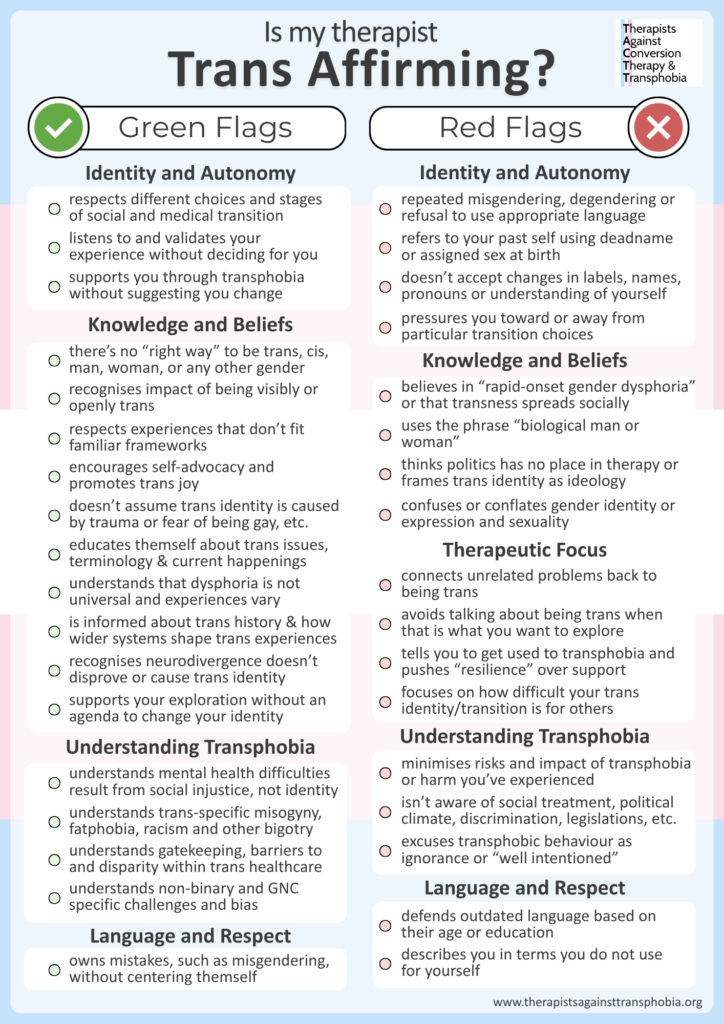
Viewing profiles and websites
Choosing a therapist is not easy. Therapists don’t always do a great job of communicating what they offer. But you should be looking for mentions that they work with trans people, or at least queer people. Pink Therapy is a directory of queer-affirming therapists that might be a good place to start. Gendered Intelligence runs courses for therapists on trans awareness. Any therapist who has done the course is on their directory.
If in doubt about whether your therapist has worked with trans people, you can ask them.
In the first session
When you’re choosing a therapist, you should pay attention to how it feels to talk to them. You’re allowed to choose your therapist on whatever criteria you like. So ask them any questions you want to, and pay attention to how you feel when they answer. It’s OK to feel uncomfortable or awkward. Watch out if you feel minimised or ignored.
Any exploration of your identity should be led by you
You can talk about or explore whatever you want to in therapy. That is your prerogative as a client. Your therapist might ask questions to open up an area of exploration and that’s all part of the work. But if you shut the question down, if you redirect it, your therapist should listen to and respect that. If they keep coming back to your gender, or something else that you’ve made clear isn’t relevant, that is a red flag.
Your therapist should listen to you and respect that your experience is yours, not theirs.
What if you begin to feel uncomfortable with your current therapist
If you feel things are going south with your current therapist, your first action should be to talk about it. There are lots of things that might be going on that are not sinister. Your therapist might not be aware of what they are doing, and calling them on it could help shake them out of it. It might open up useful areas for exploration about how you and your therapist relate to each other.
Your therapist, like everyone else, has also grown up and lived in a transphobic society. It is likely that they have biases against trans people that they are not aware of and when you call them on it, they can work on it. They might be grateful for your pushback. Certainly, I know that I have been.
However, intentional and deliberate transphobia is something else. If you push back against your therapist and it is not heard, and there isn’t a good faith attempt at hearing you, that’s a problem. If that’s what has happened, my instinct would be to try again but if that’s not working, you can speak to your therapist about ending.
I welcome trans clients
I am a queer-affirming therapist. Trans people are welcome here. Part of how I work is exploring the ways you might have to hide or abandon parts of yourself when you were growing up and in your day-to-day life now. We can explore all of this, if you want to. And if you don’t, that’s fine too.
If you want to get a sense of me first, you can schedule a free 15-minute call. No obligation, just a vibe check.