No one can predict the future. All we can do is look at the present. And as I write this (July 2026), the UK is in the middle of its longest heatwave ever recorded. It is still not over. It’s only mid-July. We have a lot of summer to go.
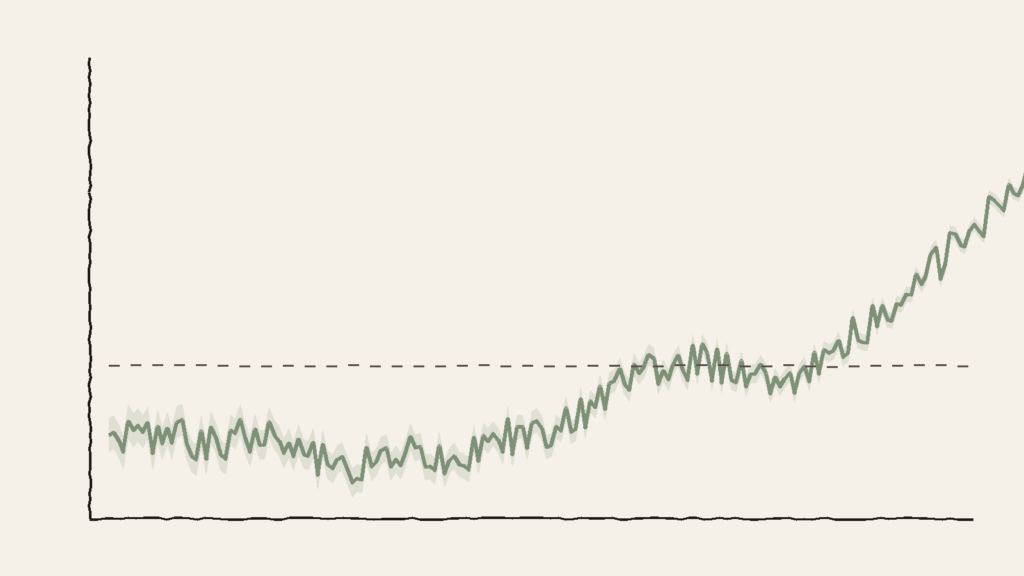
No one can predict the future. But we can look at the UK’s temperature record. In its most recent State of the UK Climate report, the Met Office found that the last three years were all among the UK’s five warmest on record.
No one can predict the future. But we know that carbon dioxide emitted today will take years before it reaches its full warming potential. Whatever the world looks like in the long term future, things will get worse before they get better. Knowing this, what do we do? We still have rent to pay, we still have people to love. We still have dreams and ambitions. We still have to live. I can’t offer you reassurances or false promises. That’s not a solution to climate anxiety, connection is.
Climate anxiety and denial
The world is built on climate denial. We’re familiar with this as a political idea. Those who deny it explicitly, those who legislate for business as usual. But back on the ground floor, climate denial is often subtler. You might struggle to believe that what’s coming is coming. You might know all of the facts, but somehow that knowledge is kept at a distance. It might feel as though you have to lock that knowledge away, in order to live; in order to feel safe. I know that I do this. The climate is destabilising, and the knowledge of that fact is destabilising too. But locking it away comes at a cost. If your anxiety is kept at a distance, it can’t be met or processed. Denial insists that your mind is kept in two states — knowing that something is wrong, but also somehow not knowing. You understand rationally what is going on, but in your body, the feeling cannot move. It is stuck. And so denial comes with a double tax. There’s the worry of the denial itself, and that gnawing, stuck feeling of it not shifting. I think that we should all stop paying this tax.
Climate anxiety therapy can help with this, of course. Together, you and I can create a space where we can look at your fears of what’s to come and process them together. We cannot, in the confines of the therapy room, re-engineer the atmosphere, but we can bring some of what worries you into the light. We can, perhaps, defang it, if only a little bit. This isn’t to deny what’s happening or minimise your worries. Those are valid. But what might happen is that you begin to see the importance of your life within the context of climate change. You might begin to see that your life, your precious and only life, is important; that it matters, even as the world around you feels so uncertain.
Connection reduces climate anxiety
We are hurt and healed in relationship. In relational therapy, we work on your relationship to other people. But what if that applied to the natural world too? Many people have written far more beautifully than I ever could about how restorative nature can be. Wordsworth, Mary Oliver, Thoreau. What if all that was true? (If you’re reading this, I suspect that you already believe it is.)And so if the world feels uncertain, if the world feels scary, I would invite you to let in the natural world. Walk in the park or better yet, go for a hike somewhere, go camping. Allow yourself to bathe in the beauty of the natural world, take it all in. And share it with the people you love. Talk to them about your climate fears, about your worries, about anything really. Not enough people do that. You can also do more than talk. I don’t know your situation. I don’t know what your finances are like, what visa you’re on, or your mobility. But I do know that working together with people I loved changed me. It moved me away from a place of stuckness and powerlessness, into a space of power. I felt free. I felt alive. My activism may not have saved the planet, but it certainly saved me.
However you manage the coming years, allow yourself to grieve. Please. The Earth is a wonderful place. Everyone you have ever loved lives here. All of your happiest memories, and your saddest ones, take place on it. But the Earth is dying, and (some) humans are killing it. You can feel angry about that, you can feel sad, but mostly, you have my permission to feel. Your life matters not in spite of the climate crisis, but because of it. The sadness, the anger, the fear you feel is the price you pay because you care. Do not shut yourself off. There is a radicalism in rejecting apathy.